After a considering moment, I came back with "I'll get fruity furniture, like chaise lounges, and I just don't want any lip about it." We both found these demands reasonable. And so it has gone.
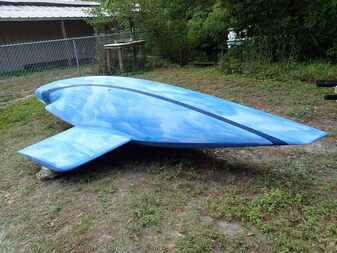
The boat is large enough for a single person, who sits inside the hull with not much more than a noggin showing above decks. As if Paul Bunyan had taken to the high seas, or as if a person had inexplicably shrunk down into a shoe.
9 Comments
My childhood bestie, Care, reminds me from time to time about how it used to go down. She'd come next-door at the cottage on a summer morning and ask if I wanted to do something: swimming, running around á la wild mustangs, making miniature ballrooms in the field, catching rabbits. 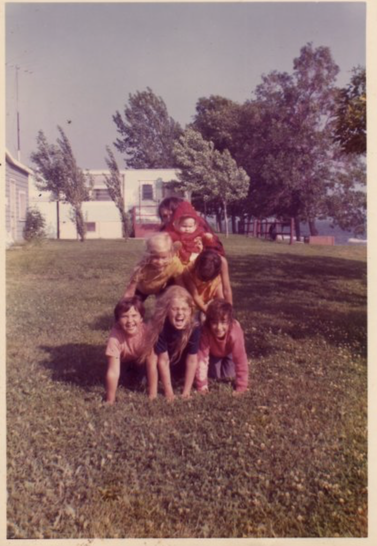 I remember spending those summers perpetually in motion, but evidently there were too many times when my answer was the dreaded, "Nah, I'm reading."
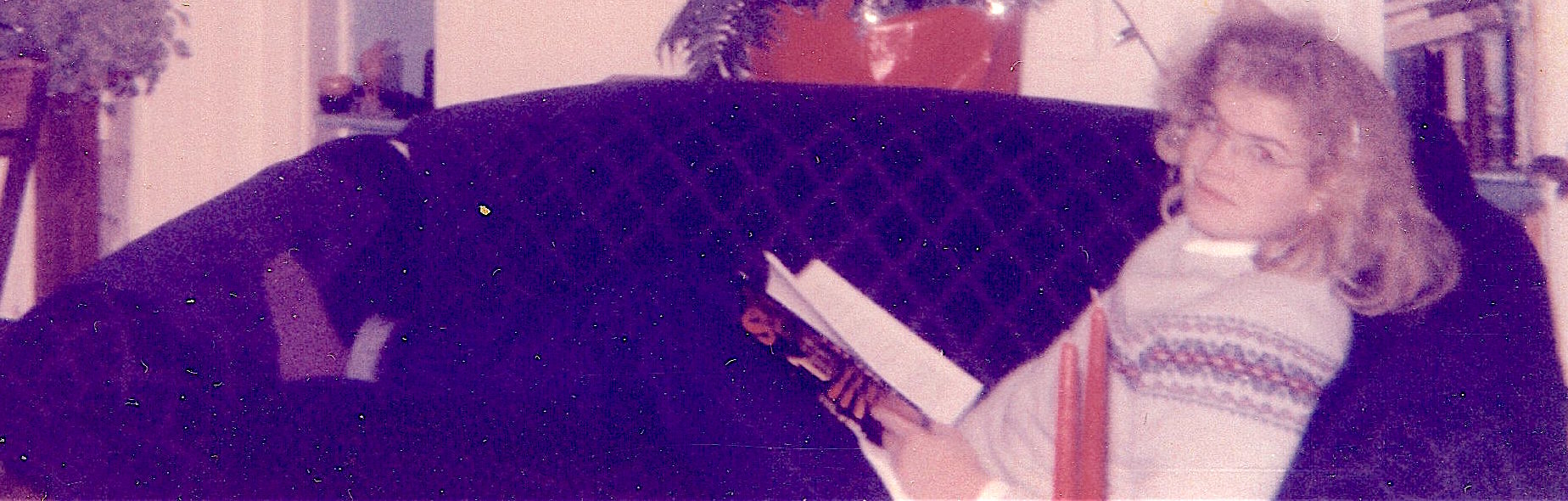 So far anyhow. Some years I read less, but mostly I read a lot. Quickly. I go heavy on novels, light on memoirs. I snack on essays and take sparse sips of poetry. I almost never read biographies. (That 5th-grade assignment on Betsy Ross <shudder>) Generalized history gets a pass, but I do like specific topics (The Black Death in 1348, anyone? Rats in New York? ) and anything natural history-ish. Stacks of books sprout wherever I perch: volumes I mean to read, books I have started, tomes I use for reference. When Mr. Linton and I downsized, I culled about a third of my collection and still needed to rent a scissor-lift to get the rest of them up the stairs. Sidebar Truth: While waiting for the delivery of the scissor-lift, and knowing the advantageous tide would wait for no book, Mr. Linton trotted the literal ton of books up stairs on tireless feet without a single complaint. Bless him. I have reading recommendations the way pharmaceutical reps have sample packs and cronuts -- with roughly the same goal. Minus the commission. 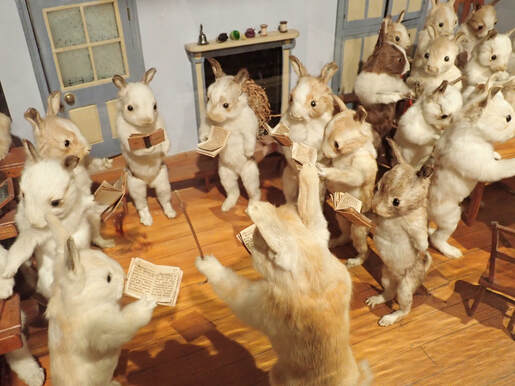 Goodreads, which is connected in the cross-platform sales way of the modern world to Amazon.com (which is to say, Amazon owns the "social cataloguing" website), has become my preferred way to keep track of titles. Instead of jotting down book recommendations on scraps of paper and then scotch-taping them someplace handy, a user can type in the name of the book (or a close approximation) or the name of the author and save it to the shelf of Books to Read. Were I a slightly more nimble consumer, I could obtain any book with a few keystrokes, but my connections are not so tight. Diversifying my stream: I read physical books that I buy. I read physical books that I borrow from the library. My sister (bless her!) gave me one of her extra Kindles, so I read on that, or on the iPad. We listen to books on CD or as podcasts or digital files. I whittled a few titles off the "Books to Read" list recently and discovered one of my favorite bookchoices for the year. Some friends may be getting a copy of The Fly Trap by Fredrik Sjöberg
Like all the best memoirs, the book –– slim, but promising to continue in another two volumes –– is not so much about Sjöberg's insects, but about what he has learned from his pursuit of them. I should be more embarrassed at my giddy fan-girl response to Sjöberg's story, but as my companions will attest: I cheerfully read aloud whole pages for their enjoyment as well as my own. My mumsie used to call it "burbling," the sort of cheerful, not-terribly-important chatter that doesn't –– strictly speaking –– require an audience. As nice a term as any, and onomatopoeic to boot. A propensity to burble was perhaps one of the reasons she sent me to kindergarten a little early. I've always had a lot to say. I've tacked away from sailing as a topic to burble about (about which to burble?) for the past couple of months here on the blog, but it doesn't mean that I haven't been writing about sailing.  A start of the Lightning Pan Am Trials at Davis Island YC. So for those sweet readers who tell me they enjoy this sort of thing, here are a couple of links to the Flying Scot webpage.
I've been doing an occasional column about boat names there for my Bar Harbor buddy Ned Johnston (Hi Ned!), who edits the class newsletter. "Sing a Song of Sixpence" Page 18 of https://www.fssa.com/files/scots_63_4.pdf "From Another Shore" page 16 of https://www.fssa.com/files/scots_63_3_web.pdf "THAT Name" page 12 of https://www.fssa.com/files/scots_63_2.pdf "What's in a Name" tag 11 of https://www.fssa.com/files/scots_63_1.pdf I recently re-discovered this tale I wrote in the early 2000's. This adventure pre-dates the Would-Be Farm (though I was dreaming about it back then!) and some of the principals are no longer with us, but here it is, a retread road-trip...  I'd been helping my sister Sarah fix up her first place up North –– after a long break away from the North Country –– when we decided to spend a day away from the project. I was in the market for some land, imagining (perhaps foolishly) that I could purchase a chunk of attractive brush with some water feature that would keep Mr. Linton and me happily occupied for the next few decades of summertime vacation. Turns out, of course, that there are many chunks of brush, some attractive, a few with water features, but almost none in my small price-range offered by anyone actually willing to close a deal. Anyway, it gave me a nifty excuse for pottering around the back roads of rural Northern New York State. A classmate from high school was a real-estate agent, and although she was out of town on vacation that week, she had provided me with a stack of property listings to look at. On our day off, my sister and I set a goal of checking out a couple of those places (disappointing: peaceful retreats are rarely located within ear-shot of Fort Drum’s gunnery range). After the unproductive real estate perambulations, our thoughts turned to something more rewarding. For years, we had heard about the reputed natural bridge over Perch River outside of the village of Dexter.
I was driving down Middle Road. My sister was navigating and she said, "Hey, turn here." A mailbox marked the turn, and I said, "Sis, come on, this is someone’s driveway." Implacable, she repeated, "Turn in."
And we got out of the car with our water bottles and our hiking boots and all we heard was birdsong, wind in the treetops, and the whine of a distant chainsaw. We consulted the map and oriented ourselves toward the river. We were preparing to trespass. She’s like, "Okay, here’s our story: We are here looking for a friend from high school, and have gotten turned around somehow." The sound of the chainsaw drew suddenly much closer. I though, gosh, maybe I should have availed myself of the facilities when we stopped at the library in Dexter.
Without even exchanging a look, my sister and I dropped the lie. We explained that we grew up around here, and we heard that there is a natural bridge over the Perch River somewhere nearby, and we were really hoping to find it. The woman said, "Why yes, there is. Do you have a half an hour or so?" Next thing you know, the woman has collected her husband, who pilots a zippy ATV down the driveway to pick us up and they are taking us on a tour all over the 400 acres their son and his wife purchased a few years back. There’s Perch river. There’s the bridge -- a smidge underwhelming, but aha! ––there’s the river emerging again from the other side of the natural bridge. There’s an old stone fence. Maybe the fence butts up to the Hall’s farm ––The Hall’s farm that was probably our Riggs family farm a hundred years ago. Maybe one of our great-great uncles stacked those very stones.
As it happens, the husband is connected to parents of classmates of ours.
And their daughter-in-law? Turns out she is my vacationing real-estate agent/high-school classmate. We trespassed on her land. Hours later, our unexpected hosts raid my real-estate agent’s fridge for beer and my sister gets them to take pictures of the two of us in the ATV, playing with my real-estate agent's dog, and lounging on the porch with our purloined beers. Those photos of us having our disreputable way with other people's porches, off-road recreational vehicle, and beer might possibly have been taken on an early cell phone that was unable to resist water when it went swimming. But maybe one of those images will resurface, possibly on the tee-shirt of one of the great-grand nephews or nieces, who will point to it while trespassing and say, "Perhaps you know these two characters? Our aunts?" And here's hoping it will parlay into a free pass, a tour, an anecdote.
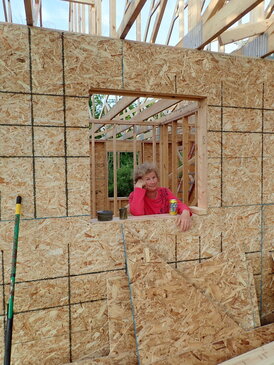
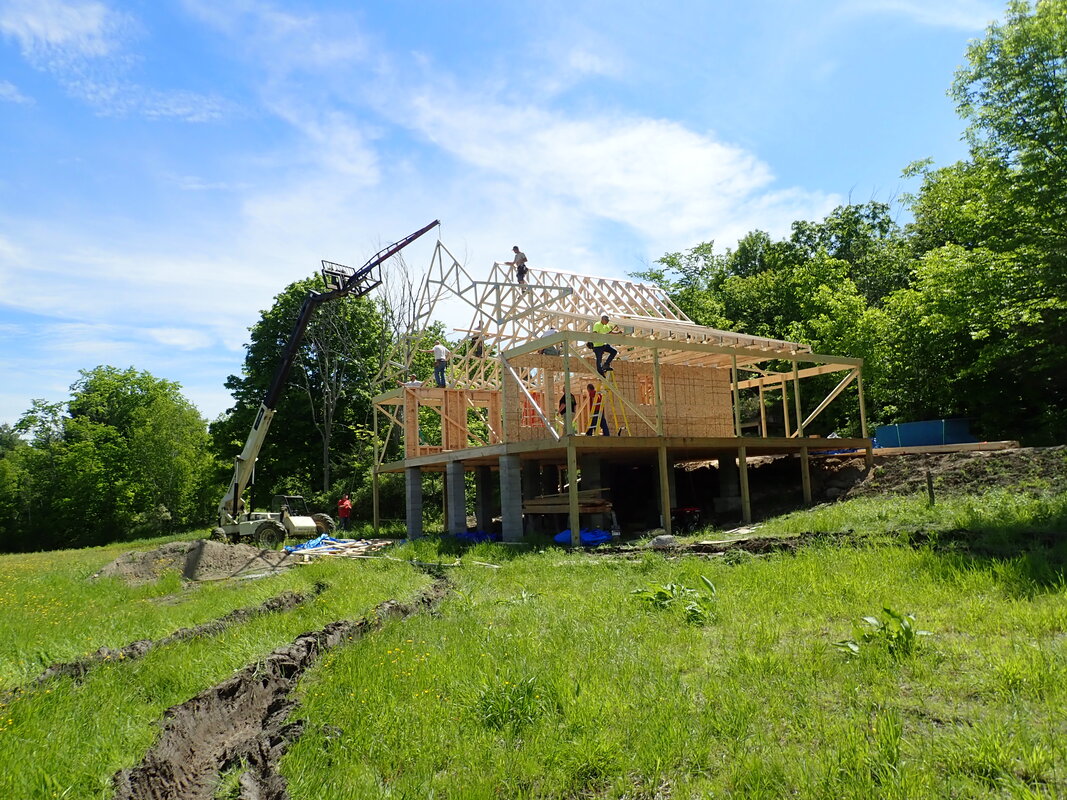
My miniature shingled cottage sits unfinished –– without him it wasn't much fun –– but Daddo and I used his power planer to make itty-bitty hardwood floors, and we constructed nifty little jigs and clamps scaled to handle the delicate woodwork of the house. He helped me fabricate plaster fieldstones for the chimney. We had a ball. At one point, when I had decided to scoot the dormer windows of the cottage a fraction closer together, Daddo looked at me and said, "You're going to make a contractor tear out his hair." Not exactly a life goal, but... I like to think I know my mind, but the thing is, it's hard to visualize construction until it's up... We returned to the Would-Be Farm in June and were not disappointed to see progress. The trusty stone-quarry guy had installed a nice gravel driveway right up to the build, including culverts and a sweet level parking area that will be ideal for our friends with motorhomes. And by the beard of mighty Hephaestus himself, the contractor and his gang were busily putting in trusses.
Ahhh. Trusses. With trusses, a girl can visualize what the place is going to look like...
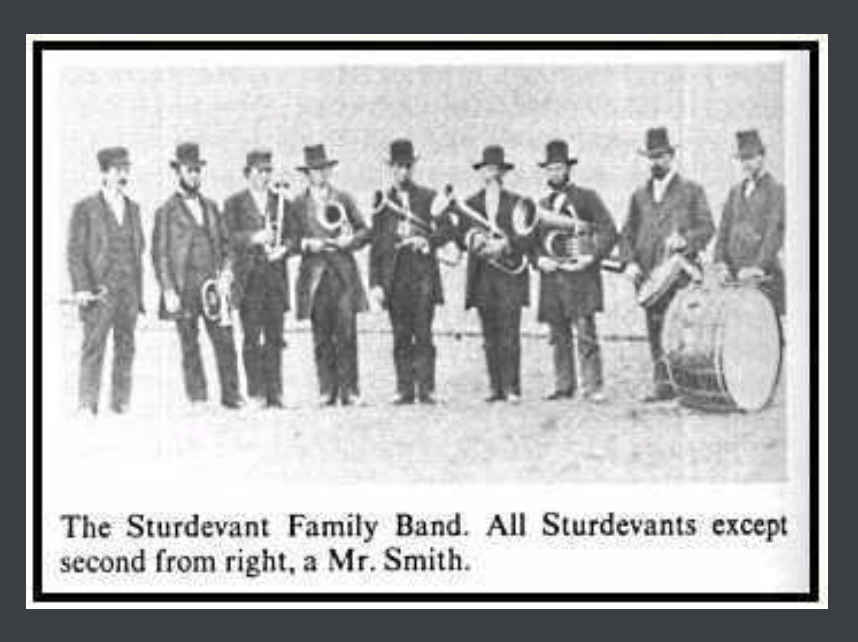
The internet is one supersized overshare. Along with the thousands of selfies and blogs about piffle, plus all those YouTube videos about optimal application of eyeliner, surviving the Apocalypse, cleaning scallops using a shop vac, and SO much more, sites beyond number offer deliciously random information to the careless researcher. And by careless, I mean "easily distracted." By which naturally, I refer to myself. I was on the track of my namesake 3x gr-grandmother, Amy Cole Hall. She lived mostly in Pennsylvania, but also in Litchfield, Connecticut. 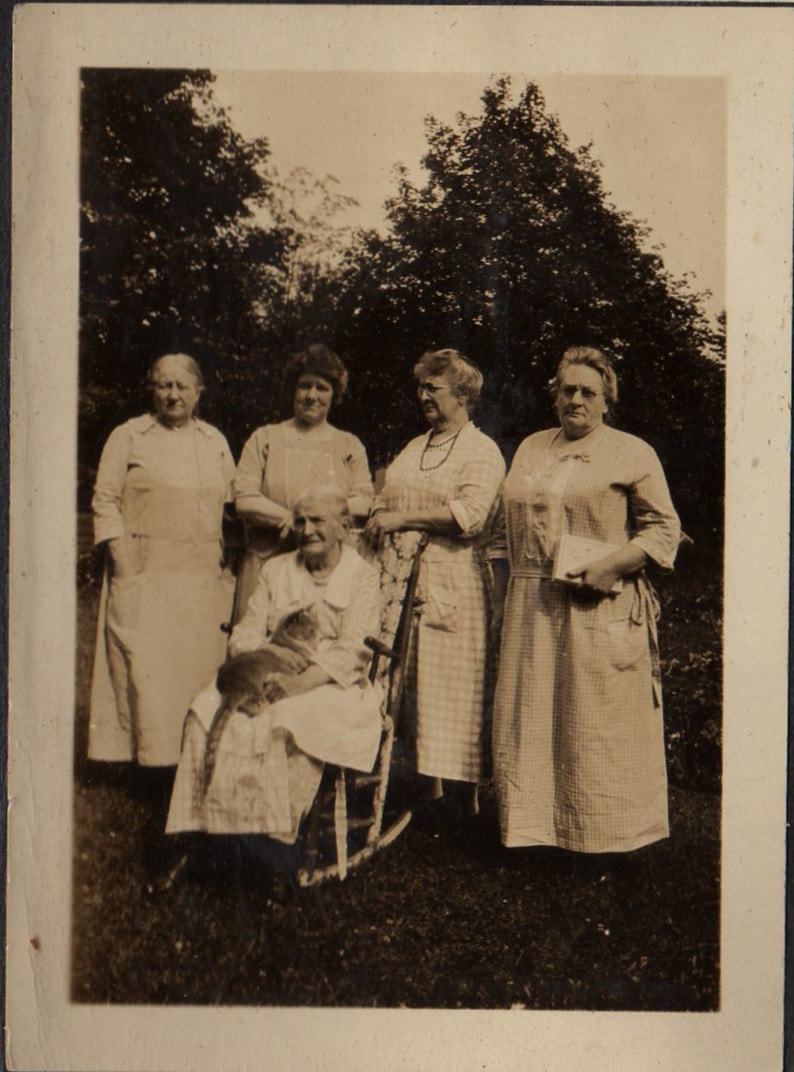 Amy Cole Hall (with cat) and her daughters and possibly a sister or two.. . Somehow (and it's always a bit of a click-mystery) I ended up on someone else's compilation of documents pertaining to their ancestors, the Sturdevants of Luzerne, Pennsylvania. Naturally, I started reading. The Sturdevants connect to another branch of my family, but I didn't know that at the time. Oh the eternal difficulty in resisting the temptation of other people's letters... An exerpt from a letter 14 Oct 1842 from Dr. George Lane Keeney to Salmon Keeney, quoting from a letter from brother Seth: "My wife has been counting up while I notched a stick, and we find we have (9) nine living children, 4 girls and 5 boys."* Does this seem –– um –– peculiar that a married couple needed to notch a stick to count their living children? The internet link to the letters is here. Also among the paper-trail of the Sturdevants is what might be some of my new favorite letters* of all time. Anyone who commits words to paper is aware that the record will live on; it's kind of the point of putting words on paper, right? I made a sound recording of one letter –– both for the interest of clarity, as the grammar and spelling was irregular, but also because it was fun to voice those words. *My previous all-time favorite letters? A series of wonderful schadenfreude-inducing Christmas newsletters from a certain childhood friend's unhappy wife (oh! how I looked forward to those each December! Even after their divorce, I kept getting these little masterpieces of misery bedecked with images of holly and jolly St. Nick! I should be more ashamed to enjoy them, but she had such a way with passive aggression!) In any case, herewith the letter 7 June 1842 from Asahel Keeney to his brother Dr. George Keeney. It's a brutal catalogue of local gossip. Burn baby, burn. There's another letter to their sister, Amy Keeney Hall –– not my Amy, but of interest anyhow –– mentioning that poor pitiful Phebe Wilson, who "quit hur husband to keep from starving." Brother Seth writes "we callculated to have visited you this fall but my health prevented If I live untill another fall I will be sure to visit."
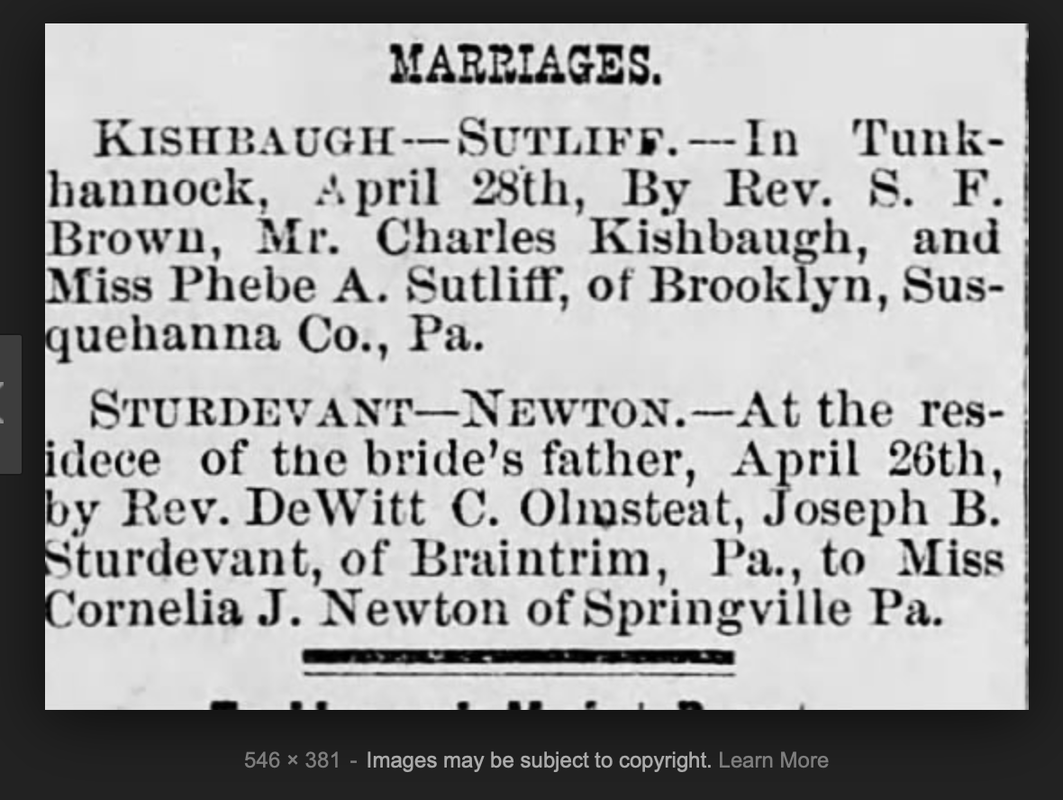
I hope he had the chance. All happy families are happy in the same way, Tolstoy wrote, but every unhappy one is unique in its misery. Poke around in the high canopy of the family tree, and you see that unique as unhappiness may be –– still, patterns emerge. Familiar patterns even. Abandonments and early deaths, illness and poverty, and of course, like smoke seeping from under the rafters, scandal.  Like this one: My gr-gr-grandfather Newton had a bunch of siblings. I don't know much about them. It's a long time ago, and over years of research, I hadn't located half of their graves in our tiny farming hometown. But sometimes you return over and over to a stubborn nut, giving it the odd yank, and it will loosen. One of those siblings was Cornelia Jane Newton. Born in 1837 in Dimock, Pennsylvania (about 15 miles from where I was myself born a few years later), she was buried in Nebraska in 1912. First, okay –– Nebraska? That's worth thinking about. Turns out she married late (at 34) to Joseph Blanding Sturdevant (another long-rooted family from that corner of Pennsylvania) and the two moved West with a group of like-minded Methodists in the early 1870s.. She and Joe had four kids (a son died at 14), and at the end of her 75 years, she was living with her daughter, Sarah Lorena Chittick. Cornelia Jane's obituary paints a certain kind of picture of the former schoolteacher: "If sometimes in the stress of life's conflicts, the battle pressed sore, faith, courage and Christian fortitude enabled her to bear up." 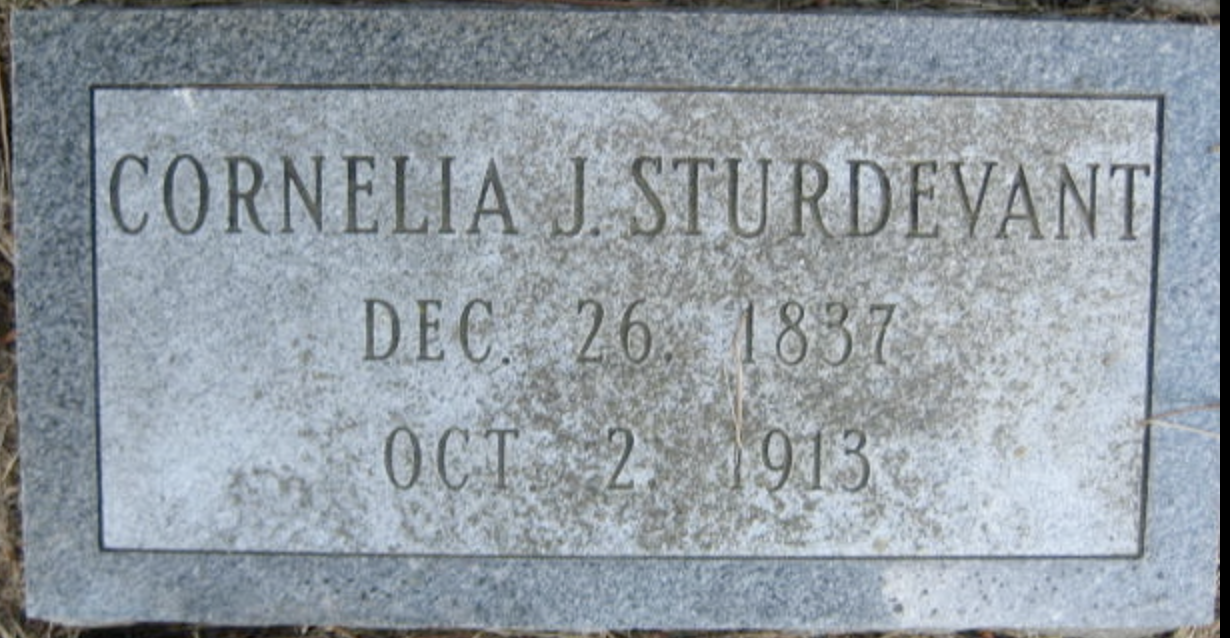 So, not an easy life for Cornelia Jane, born in Dimock, died in Nebraska.
Joseph and his new bride Rosella exchanged vows in Pennsylvania and then moved to the teeming metropolis of Kansas City. It's easy to imagine Rosella as the youthful replacement wife, possibly a hussy, and that Joseph was more than a little bit of a creeper, but that's simply too easy a story. No matter how often it happens in real life. Like they say, when the answer is too obvious, look closer: as I compare birthdates, I see that Cornelia is 12 years Joe's senior. When they first married, he was 22 to her 34. She was a school teacher. Oh lawsie, I wonder if she was his school teacher. Turning the tables on who's the creeper, maybe.
The imagination boggles. To divorce in 1880, and then –– a period of seeming quiescence, where Cornelia and Joseph both lived in the same small Nebraska town? Then for him to marry Rosella?
What truth could match these data points? Did somebody have a breakdown? Perhaps Rosella was the original object. Perhaps Joseph just liked the family. Perhaps Cornelia organized the hand-off. Perhaps there was a lengthy epistolary courtship with letters coming in the mail. Perhaps one or the other was merely a marriage of convenience. I can see the new couple moving away from Nebraska. After all, Cornelia lived there, as did another older Newton sister, Catherine (and I wonder what she thought about all this), but why Kansas City? And, finally, how would a researcher ever know? Rosella and Joseph had no children (Or did they? Joseph's youngest is named Rose Ellen, born in 1879. Though a dozen documents say otherwise, one outlying reference lists her as the daughter of Rosella, and that she was born in Pennsylvania, not Nebraska). But again, if the children were Cornelia's, the surviving generations necessarily favor Cornelia's side of the drama. It's possible that there was no drama. Except seriously, what happened?
Not that any of us should wait for a special day to recognize the good fortune and lucky stars that has got us this far so far. But tis actually the season for this sort of thing. Plus feasting. Ah, feasting. We have missed a few years of Thanksgiving in the States. So the groaning board seems novel this year, despite its familiar elements.
In England, I discovered that treacle cake was in point of fact, a too-sweet syrup-drenched wet bread mess. Such a disappointment after all those jolly British boarding-school novels! Wet breads. Gah. *In strict honesty, I know some people make stuffing more often than once a year. I dated a boy who made StoveTop at least once a week. For himself. Still, there are stuffings and StoveTops, and the latter does not make or break Thanksgiving.
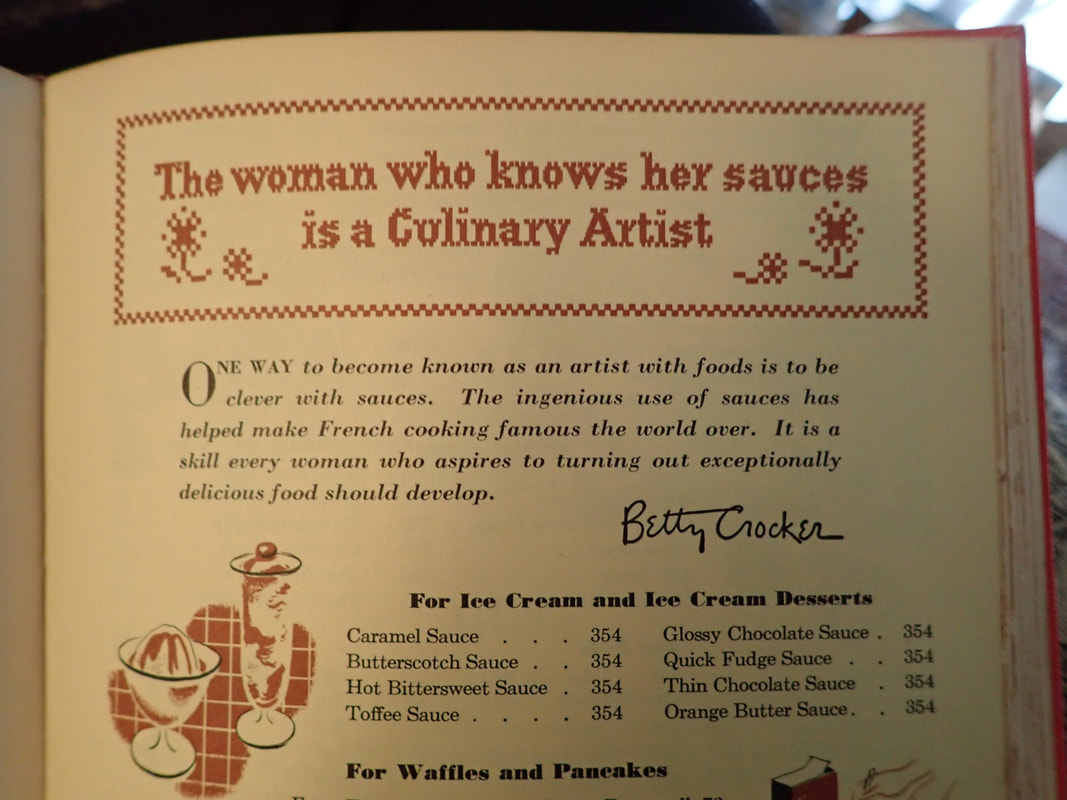
Anyhow, the single element that proved it was Thanksgiving in Mumsie's house? Oyster stuffing. Technically a wet bread, the recipe includes saltines, "dots of butter," oysters, milk, salt and pepper, all baked in a casserole. Mumsie's cousin Shirley (Hi Shirley!) continues to make this family dish for Thanksgiving in Pennsylvania. I haven't had the heart to make it –– or mincemeat for that matter –– absent my mom. Well, that and my casein intolerance thingie. Making oyster stuffing my orphaned orphan dish.
Plus, we get our money's worth out of that bubbling vat of peanut oil. Perhaps as time marches along, I'll see the evolution of the meal go farther yet afield. Tofurky maybe, or into the funky Cajun science of the turducken. Both of which appall my Yankee sensibility even as the latter –– wet bread filling notwithstanding ––does pique my curiosity.
Well, I promise to be thankful if I have the chance to see that. My Daddo was petrified of snakes. A traumatic childhood canoe mishap rendered him and his sister and his mother all terribly snake-averse. In later years, he referred to them as "serpents" in a mostly ineffectual effort to keep from getting the willies* when talking about them.
Mumsie was seriously afraid of spiders but pretty much loved any other living creature in the world. She said, "Oh, for pity's sake. Put them down before they warm up and start biting you." 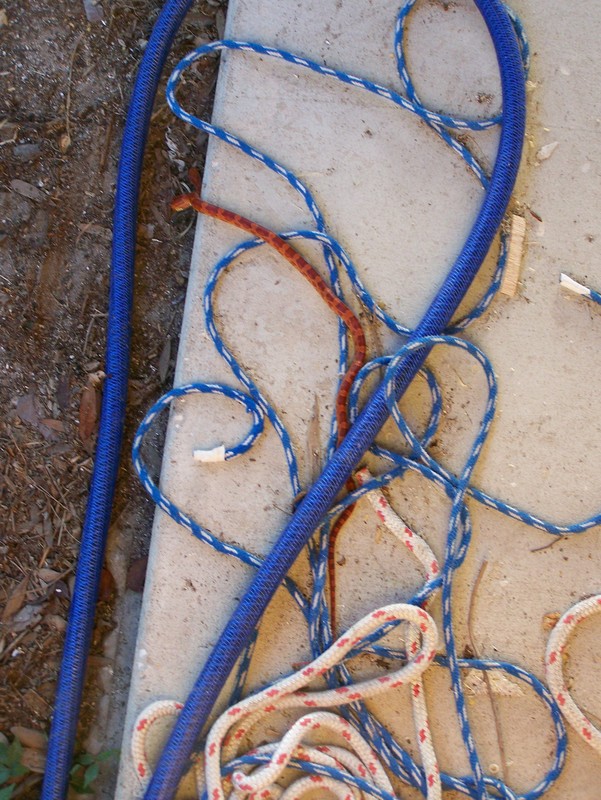 Lo these decades later, the vaccination still works. A little corn-snake lurking among some line doesn't bother me one bit.
I wonder if he imagined he was invisible. He didn't have much of a grip on how complementary colors work on the color wheel. It's a like scene from a Michael Bay film. *Ooh, yeah, that Flickr site: so there's someone who re-creates Gary Larson's Far Side cartoons using Legos. I may have reached the end of the interwebs.
*The Works of Mark Twain; Early Tales & Sketches, Vol. 1 1851-1864, (Univ. of California Press, 1979) But at the top of mind, there's the question of the couch. At least for me, anyhow, New Year's is a couch issue. It's like the pull of an annual migration, or whatever impulse that makes bears and porcupines wake up in the spring. Midwinter and its myriad festivals of light and sugar-cookies pass and I look around with a sense of urgency like a vulgar itch. It's time to rearrange the furniture.
At the literal end of the day this year, the living room is still in a bit of disarray. Turns out the little red chair and foot-stool were ready to retire. Ten years of service in a home-made slipcover? Okay, then, go on, thrift-store find, thanks for your service!
Plus, the inexpensive IKEA rug I picked up to cover more square footage of the plywood floor is –– to the inch –– the exact same inexpensive IKEA rug I have had for four years. Whoops. (A foolish consistency would be the hobgoblin of little minds, just ask Ralph Waldo Emerson, but this? This consistency shows unflappable design taste, baby.) But the drive is wearing off. I think the impulse that kept me hustling around the house today is almost the opposite of a resolution: I make no promises for the coming year. The work is done, aside from returning that rug and a bit more cleaning. In the coming weeks, I'll be utterly guilt-free as I think less and less about the process. And by May, I too will have forgotten humbug promises and the shiny sense of a whole new year full of potential and improvement. |
About the Blog
A lot of ground gets covered on this blog -- from sailboat racing to book suggestions to plain old piffle. FollowTrying to keep track? Follow me on Facebook or Twitter or if you use an aggregator, click the RSS option below.
Old school? Sign up for the newsletter and I'll shoot you a short e-mail when there's something new.
Archives
April 2026
Categories
All
|




 RSS Feed